

ANT016 - Streams of conscious
Turning inward to books that bring us deeply into someones internal thoughts and mirror the chaos of our minds.

I’ve always marvelled at how the best writers create characters. Well, not so much create them but bring them to life - reveal their minute intricacies and idiosyncrasies.
It is, of course, impossible to ever truly know another person. Yet some books make me feel as if the writer has come to understand someone else, or someone invented, more than I understand myself. Or may be it is more an act of ‘noticing’ than understanding - so many of our own internal workings seem to pass us by.
Never is this more true than in novels that take the first person point of view to its extreme with streams of conscious. That enter a character’s head so directly that there is nowhere to hide - the author becomes the character, we become the character.
The facts tell us that these books are not written by the character, but the author. Following on, all sense and reason tells us that the author must exist in the text. That this character is tainted by their own thoughts and ideals. Yet the best examples make us feel and believe the opposite. The author is nowhere to be seen. The blurry line where the two start and end is forever intriguing, but if the author ever comes too close to the surface, close enough for you to feel their presence, then the entire illusion is shattered.
First-person seems to have been un-trendy at times, at least in literary circles. Maybe it doesn’t have the gravitas of third person’s all seeing eye or the ability to comment and philosophise from a range of point of views. But there is something about the intimacy of ‘I’ that draws you in. Novels are often a chance to be witness to things we wouldn’t otherwise. A pessimist could say they appeal to a nosiness in us, but I believe that with a care for and interest in the world and the people in it curiosity becomes only natural. What more appealing and impossible place to witness than someone else’s mind?
“Today a young man on acid realized that all matter is merely energy condensed to a slow vibration, that we are all one consciousness experiencing itself subjectively, there is no such thing as death, life is only a dream, and we are the imagination of ourselves. Here's Tom with the Weather.”
Bill Hicks
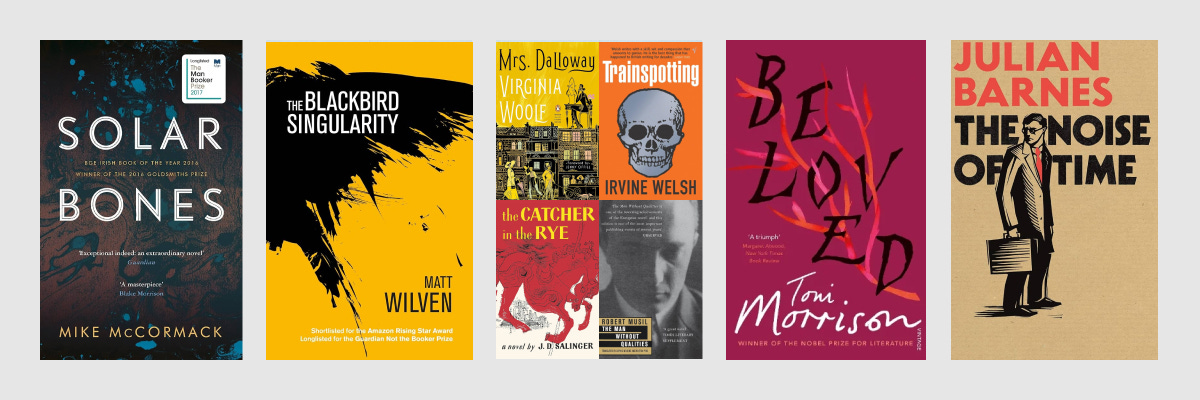
Mike McCormack’s Solar Bones (2016) starts stuttering, the mind we are in seeming to form itself or find its voice as we read. The mind is that of Marcus Conway, a civil engineer who’s profession very much mirrors or affects how he looks at the world and his native County Mayo (Western Ireland). The day is 2 November 2008 - All Soul’s Day - a day when the said are said to rise. From his kitchen - the house where he and his wife have raised two children and lived for twenty-five years - his thoughts fan outwards across Ireland, Europe and the world, covering not only his life and relationships but the politics, philosophies and events that are the context to it. The power of the book is in the flowing ease with which McCormack achieves this, but also in his character Marcus’ uniquely detailed, at times mathematical way of analysis.
were we so blind to the world teetering on the edge that we never straightened up from what we were doing to consider things more clearly or have we lost completely that brute instinct for catastrophe, that sensitivity now buried too deep beneath reason and manners to register but which, once upon a time, was alert to the first whining vibrations radiating from those stress points likely to give away first
Mike McCormack - Solar Bones
Since losing his young son, the narrator of Matt Wilven’s The Blackbird Singularity (2016) has been taking Valium on prescription. Until, inspired by his wife unexpectedly becoming pregnant again, he stops. The result is, at first, a sense of mental clarity, a feeling that, as a writer, he is doing his best work. Then it is an initially harmless affinity he begins to feel with a blackbird in the garden. Then signs and portents all around him and the blackbird prophesising his future. As his creativity descends into mania, we follow his journey so closely that it begins to feel like a natural reaction to the grief he is living with. An acute study of grief and madness, Wilven achieves a novel that pulls us into its psychosis to leave an intense impression.
Lyd is making a rocket, walnut and avocado sandwich. I’m pacing around the kitchen, being a bit useless. We’re listening to Robert Johnson on the stereo. Whenever Lyd moves I seem to be standing in her way. Things have been strained since I packed up Charlie’s room. Lyd seems to think that I’ve crossed a sacred line, undermined all the fundamental things we hold dear, and she’s now applying the theory that I lack empath to almost everything I do.
Matt Wilven - The Blackbird Singularity
The most highly regarded of Toni Morrison’s prolific body of work, Beloved (1987) is loosely based on the harrowing life of Margaret Garner, a former-slave who killed her own daughter, and was intending to kill her other two children and herself, to spare them returning to slavery. Different to the other texts here in that it enters the mind of a range of characters, Morrison’s style is, as ever, intense and creates a brutal depiction of the lasting impact of slavery that’s both hard to look at and impossible to look away from.
There is a loneliness that can be rocked. Arms crossed, knees drawn up, holding, holding on, this motion, unlike a ship's, smooths and contains the rocker. It's an inside kind--wrapped tight like skin. Then there is the loneliness that roams. No rocking can hold it down. It is alive. On its own. A dry and spreading thing that makes the sound of one's own feet going seem to come from a far-off place.
Toni Morrison - Beloved

Alvaro Paradis rightly points out that Virginia Woolf’s Mrs. Dalloway is a classic stream of conscious narrative. Caroline Ferguson adds that previously featured Albert Camus’ The Outsider and Max Porter’s Shy would fit in excellently here, while also mentioning Irvine Welsh’s Trainspotting and J.D. Salinger’s The Catcher in the Rye - all excellent recommendations. Will Ahl recommends Robert Musil’s The Man Without Qualities, a book that’s been sitting in my list to read forever and has just shunted towards the top.
“Now I have something to tell you,” her brother said. “Every time I've had to take part in anything with other people, something of genuine social concern, I've been like a man who steps outside the theater before the final act for a breath of fresh air, sees the great dark void with all those stars, and walks away, abandoning hat, coat and play.”
Robert Musil - The Man Without Qualities
Want to contribute to next issue? Watch out for DogEars in two weeks where I’ll reveal the theme. Don’t forget to include a link if you’d like me to add one to your name.
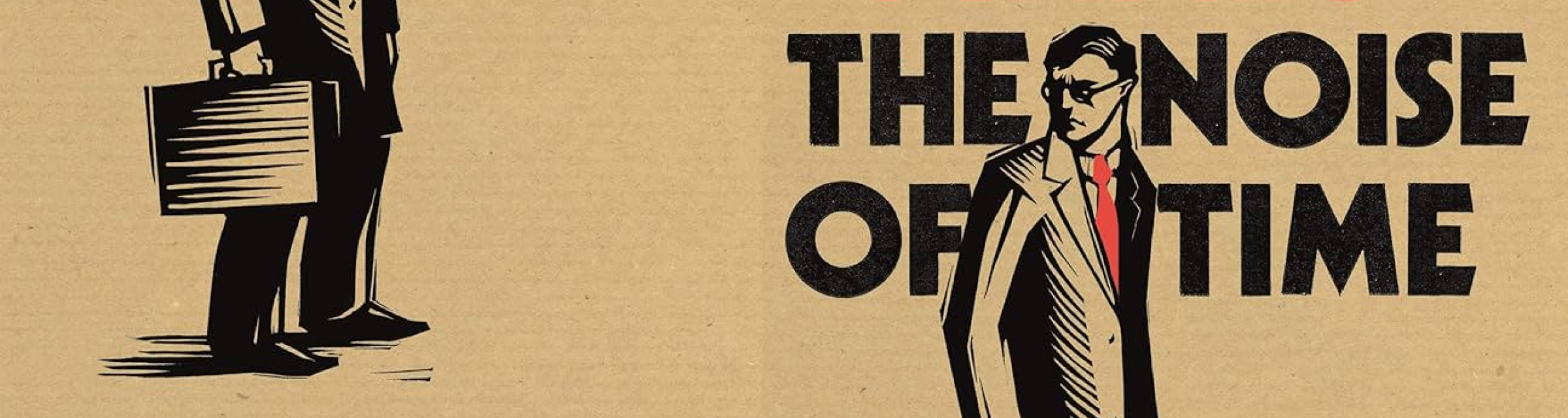
I don’t often pick up historical novels, so I’m not quite sure how Julian Barnes’ The Noise of Time - a true to life study of composer Dmitri Shostakovich in Soviet Russia under the reign of Stalin - ended up in my hands. What I remember is that something in the blurb’s vague mystery drew me in…
In May 1937 a man in his early thirties waits by the lift of a Leningrad apartment block. He waits all through the night, expecting to be taken away to the big house. Any celebrity he has known in the previous decade is no use to him now. And few who are taken to the Big House ever return.
After a damning review of his opera Lady Macbeth of Mtsensk in communist broadsheet Pravda, Shostakovich knows enough of Stalin’s regime to understand that he has been marked. That a knock on his door is only a matter of time. As it happens, he is saved by a piece of good luck, but his remaining career is spent attempting to regain favour with a political party that controls everything to its smallest details, including the career trajectory of composers such as himself. Grappling with his own integrity, he is acutely aware that his later soaring success can be attributed to his willingness to bow to the regime in fear rather than the artistic quality of his output.
Being a hero was much easier than being a coward. To be a hero, you only had to be brave for a moment - when you took out the gun, threw the bomb, pressed the detonator, did away with the tyrant, and away with yourself as well. But to be a coward was to embark on a career that lasted a lifetime. You couldn't ever relax. You had to anticipate the next occasion when you would have to make excuses for yourself, dither, cringe, reacquaint yourself with the taste of rubber boots and the state of your own fallen, abject character. Being a coward required pertinacity, persistence, a refusal to change - which made it, in a way, a kind of courage.
Told in three parts, from 1936 to 1960, it is from his conscious and memory that the book chronicles Shostakovich’s life. The events we look out from are smaller, mundane moments around history - returning to his apartment, flying from America after being part of a cultural delegation, looking out from his chauffeured vehicle. Despite the third person perspective, the staccato narrative jumps and weaves in a way that puts the reader very much inside his head. From the mundanity of delayed flights to the terrifying shadow that hangs over him, his mind is anxious and unfocused, something that is expertly portrayed to be instantly relatable.
Rather, what happened to human illusions was that they crumbled, they withered away. It was a long and wearisome process, like a toothache reaching far into the soul. But you can pull out a tooth and it will be gone. Illusions, however, even when dead, continue to rot and stink within us. We cannot escape their taste and smell. We carry them around with us all the time.
A character that descends deeper and deeper into his own shame, Shostakovich remains likeable in a way perhaps unique to stream of conscious narratives. Our vantage point is so close to him, all of the events we learn of and the indictments against him seen only through his lens, that he is afforded an almost omni-present self-knowledge that has the effect of negating his lapses of value and principle. A unique look at life under a regime of despotism, Shostakovich is the perfect vessel from which to raise the quandaries of the role principle plays in art.
“Art is the whisper of history, heard above the noise of time.”
Julian Barnes - The Noise of Time

Devin Kelly with a timely stream of conscious meditation on late Palestinian poet Mahmoud Darwish’s work and, specifically, a long poem that was one of his last published in 2008 - Mural.
And so I wondered about these lines. About what it means to wake up as a kind of death. About what it means to have more than enough of the past. About what it means to have not enough of tomorrow.
Ian Leslie with an interesting look at an archetypal British character of literature, film, TV and everyday life - The Curmudgeon.
The word has been around since the 1570s, though its origin is unknown. Samuel Johnson, the archetypal curmudgeon, thought it might derive from the French “coeur méchant’ (evil or malicious heart) but modern scholars think this doubtful. The curmudgeon isn’t malicious, anyway, he’s just grumpy, although being grumpy isn’t enough to qualify as a great curmudgeon. The grumpiness must be allied to wit, perspicacity, and purpose. It must have a point.
Psychologist Paul Bloom with (writing focused) productivity tips for the restless.
All of these writers are assuming that the problem has to do with stopping. This has never been an issue for me! I’ve always found the difficulty is, first, starting, and then, keeping going.
Maria Popova of The Marginalian riffing off Czech-French novelist Milan Kundera’s book The Art of the Novel.
A novel examines not reality but existence. And existence is not what has occurred, existence is the realm of human possibilities, everything that man* can become, everything he’s capable of. Novelists draw up the map of existence by discovering this or that human possibility. But… to exist means “being-in-the-world.” Thus both the character and his world must be understood as possibilities… [Novels] thereby make us see what we are, and what we are capable of.

As the nights draw in, I’ve found myself drawn to an album I haven’t listened to in a while - Burial’s Untrue (2007). A mysterious figure, Burial came from nowhere and landed right in the midst of the UK electronic music scene with a sound that was so unique yet distinctly tied to the country’s rainy nights and grey cities. Perfect for letting late night thoughts wander, it ties a mesmeric, shuffling darkness with beautifully subtle and moarnful melodies.

As always, thank you for being here with me. More so than ever recently I feel that there are too many books and too little time, but sharing them here energises me, a reminder of how much they mean.
Whether frothy rapids or serene, glassy water, I hope your stream of conscious flows freely.
MQ.